MotoGP is getting louder inside the helmet. Not from the engine. From Race Direction.
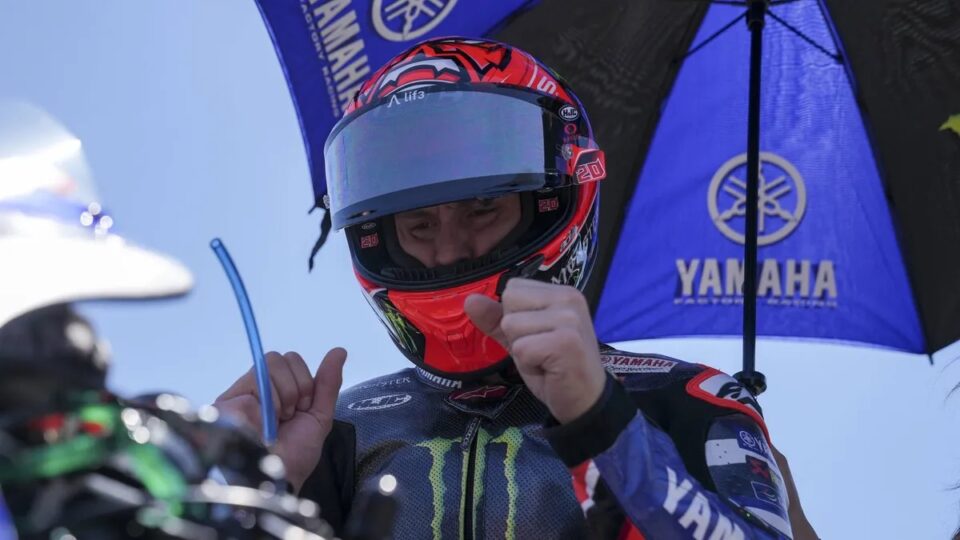
The Jerez test on April 28 marked another milestone in one of the sport’s longest running and most quietly significant development projects. Fabio Quartararo tested the latest version of MotoGP’s in-helmet radio system and described it as having made a big step, though he warned that sound clarity still needs significant work before anyone considers it race ready.
That one sentence from Quartararo tells the whole story of where this project stands. Progress. Not arrival.
Where It Started
This is not a new idea. A first version of the radio system was tested at Misano as far back as 2020, prompted by riders complaining about flag visibility and track awareness at high speed. The sport tried it. The riders hated it. The system was noisy, uncomfortable and impractical.
MotoGP regrouped. Rather than abandon the concept entirely, they pivoted to LED panels at trackside, making them mandatory at every circuit on the calendar. The riders responded positively, and Dorna considered the LED rollout a genuine success in improving flag communication.
But LED panels only go so far. A rider hitting 300km/h through a blind section does not always see a trackside panel in time. The radio project never went away. It just went quiet for a while.
How the Current System Works
The current system involves a small receiver integrated into the rider’s leathers and a speaker built into the padding of the helmet itself. This is not an earpiece jammed into the ear canal. The earpiece is positioned to contact the outer surface of the ear rather than going inside it, specifically to be as non-invasive as possible in the event of a crash.
At this stage it is entirely one-way. Race Direction sends pre-recorded messages to riders on track Riders cannot respond. The priority is safety warning riders about crashes ahead, deteriorating weather, flag situations, or emergency track closures faster than any visual system can currently manage.
The technical challenge is enormous. Unlike F1 cars, MotoGP helmets are extremely tight around the face, the machines generate far more noise, and riders move aggressively on the bike in ways that can shift a speaker pad slightly out of position at exactly the wrong moment. Quartararo highlighted this specifically, saying he could hear the system but that clarity was still the main issue.
Test rider Lorenzo Savadori, who has been involved in development sessions across multiple years, said the feeling improves every time he tries a new version, and noted that riders will ultimately adapt to connecting and disconnecting a radio system as part of their normal pre-race routine.
The Jerez 2026 Test
The Jerez test in April 2026 provided an ironic backdrop for the radio development work. Saturday’s chaotic flag to flag Sprint race, where riders had to make split-second decisions about changing bikes in deteriorating wet conditions with no communication from their teams, was arguably the most compelling real-world case for why the system matters.
Marc Marquez crashed, cut across the grass, and made a call nobody in Race Direction had directed him to make. Alex Marquez led the race on slicks in worsening rain without any team guidance reaching him through the helmet. Both scenarios demonstrated exactly the kind of situation where a direct safety message from Race Direction could have genuine value.
After the latest Jerez test, the system is described as becoming clearer, more reliable, and closer to real competition use than at any previous evaluation. That is meaningful progress for a project that has taken six years to reach this point.
What Comes Next
The roadmap is clear even if the timeline is not. The second phase of the project involves a two-way system, allowing riders to respond to Race Direction messages while on track. This phase was originally targeted for as early as 2026 but has not yet been confirmed.
The third and final phase, the one that changes the sport most fundamentally is full F1-style open communication between riders and their pit wall teams. This step does not yet have a concrete implementation date.
The long-term commercial driver behind the team-to-rider communication phase is the live broadcast. Dorna has already experimented with broadcasting engineer-to-rider garage audio on its live coverage, testing fan appetite for that kind of inside access to race strategy conversations. Liberty Media’s arrival as MotoGP’s new ownership group adds another dimension to this. F1’s radio communications are one of the most popular elements of its broadcast product. The temptation to replicate that in MotoGP is obvious.
The Purist Argument
Not everyone in the paddock is cheering this development along. The general feeling among riders and fans remains that the current flag system, while improvable, is not broken enough to justify the distraction and potential new safety risks the radio introduces. A speaker pad that shifts position mid-race during a crash is not an insignificant concern.
There is also a philosophical question about what makes MotoGP different from F1. Riders make solo decisions at 300km/h. They read races alone. That isolation is part of the identity of the sport and part of what separates the very best from the merely good. The moment a voice in the helmet starts directing strategy, something changes about what the sport is testing.
The safety-only one-way system is the easy sell. Most fans and riders will accept Race Direction being able to warn a rider about a crash around the next corner. That is just information that saves lives. Few will argue against it once the technology works reliably enough.
The team-to-rider phase is where the sport will need to have a much harder conversation with itself.
The Verdict
Six years of development. Multiple Jerez tests. LED panels as a successful interim solution. And now, in April 2026, Fabio Quartararo saying it made a big step but still needs a lot of work to sound really clear.
That is MotoGP’s helmet radio project in a single sentence. Moving. Not there yet. But moving in the right direction.
The day a Race Direction message saves a rider from hitting a fallen bike around a blind corner that will be the day the entire argument about whether this system belongs in MotoGP ends permanently.