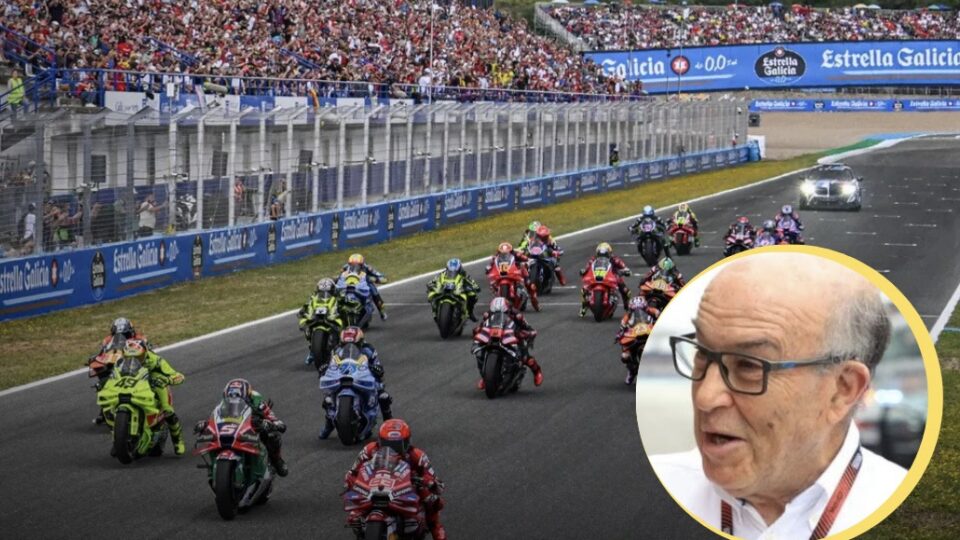
Carmelo Ezpeleta, the man who has run MotoGP since 1992, who survived the transition from two strokes to four, who guided the championship through a global pandemic, who sold Dorna to Liberty Media without blinking, stood in Barcelona this week and delivered his verdict on the biggest commercial crisis in the sport’s recent history.
We discuss contracts to fulfil them. We will reach an agreement. For sure.
Seven words. No qualification. No timeline. No visible concern. Ezpeleta at his most Ezpeleta.
The question is whether that confidence is justified or whether it is the carefully constructed performance of a man who knows far more about how close to the edge this negotiation has gone than he is prepared to admit publicly.
What Is Actually At Stake
Every five years, MotoGP’s commercial owners sit down with manufacturers, teams and other stakeholders to lay out the terms of their relationship, financial and otherwise. The current agreement expires at the end of 2026. The new deal covers 2027 to 2031, the first full cycle of the 850cc era. It is, by any measure, the most consequential commercial negotiation MotoGP has conducted since Liberty Media paid 4.2 billion dollars to buy Dorna in 2023.
Manufacturers have been demanding a 40 percent increase in financial subsidies, with payments currently amounting to approximately 70 million euros per season across all five manufacturers. They want to move away from fixed payments entirely, demanding instead a percentage-based revenue share that mirrors the Formula 1 Concorde Agreement model.
MotoGP SEG’s counter offer is a linear economic increase in the championship’s contribution to each of the 11 teams on the grid, in return for greater manufacturer involvement in hospitality, marketing, image, communication and social media.
The gap between those two positions is not merely financial. It is a fundamental disagreement about the nature of MotoGP itself.
The Timeline of Failure
The backstory to this moment stretches back further than most fans realise. The six independent teams ie., LCR, Pramac, Gresini, Tech3, Trackhouse and VR46 reached an agreement with Ezpeleta last autumn. That was the easy part. The satellite teams need the manufacturers to supply bikes. Without an MSMA deal, there is no championship for anyone.
In Austin, manufacturers emerged from a crunch meeting with Liberty Media describing themselves as happy and hinting that 2027 rider deals were imminent. That optimism evaporated within weeks. At COTA, the gap between the two positions made even a symbolic handshake agreement impossible.
By Jerez, the situation had deteriorated to the point where Aprilia, KTM and Yamaha boycotted Liberty Media’s official paddock dinner, an annual event at the Bodegas Gonzalez Byass that is one of MotoGP’s most significant social gatherings of the European season.
The morning after that snub, MotoGP SEG abandoned its united negotiation strategy entirely, switching to individual conversations with each manufacturer and team separately.
The Le Mans Deadline
MotoGP SEG set the French Grand Prix at Le Mans as its deadline for reaching an overall agreement. The paddock arrived in France this week knowing that this weekend is not just about Bezzecchi, Marquez and the title fight. It is about whether five motorcycle manufacturers and the world’s most powerful sports media company can find enough common ground to keep the greatest motorcycle racing championship on earth running after 2026.
Ezpeleta dismissed the deadline publicly, insisting there are no fixed timelines and that by March next year all manufacturers will have their bikes and riders ready regardless. That statement is technically correct. It is also diplomatically crafted. Ezpeleta is not saying there is no deadline. He is saying he does not acknowledge the deadline which is a very different thing.
The deeper frustration for Ezpeleta is strategic rather than financial. He sold Dorna to Liberty Media on the basis of a proven, profitable business model built around fixed payments and controlled costs. The manufacturers are now demanding Liberty change that model entirely which means Ezpeleta is being asked to undermine the commercial framework he spent 30 years building.
Honda Signs. Yamaha Holds. Ducati Waits.
The manufacturers are no longer operating as a unified bloc. Honda has committed to signing the new agreement. Yamaha remains the manufacturer most firmly opposed to the current proposal, alongside Aprilia and KTM.
This is exactly what Liberty’s divide and conquer strategy was designed to achieve. The manufacturers had been holding back their 2027 rider announcements as a collective bargaining chip. Once Honda breaks ranks, the unity that gave the MSMA its leverage begins to crumble.
MotoGP Chief Sporting Officer Carlos Ezpeleta put the manufacturers’ position bluntly at the Thai round earlier this year: everybody is excited about the sport and nobody wants to leave. But if they want to be part of the success, they need to be proactively part of that success too.
That is Liberty’s core argument. You cannot demand Formula 1-style revenue sharing while refusing Formula 1-style commercial obligations. The manufacturers want the profit without the promotion. Liberty says that is not how it works.
The Rider Market Hostage
The most visible casualty of this stalemate for fans is the 2027 rider market. Almost every major seat is decided. The manufacturers have been deliberately withholding official announcements as a collective bargaining tool. Quartararo to Honda. Acosta to factory Ducati. Alex Marquez to KTM. None of it confirmed. All of it ready to be announced the moment signatures go on paper.
The only confirmed 2027 piece of the grid puzzle is Marco Bezzecchi’s Aprilia renewal itself a strategic MSMA announcement designed to show Liberty that manufacturers can play ball while withholding everything else as leverage. The delay is directly costing teams and riders clarity on their futures, with signings and renewals already agreed on paper unable to be formally announced until the commercial framework is settled.
What Ezpeleta’s Confidence Actually Means
Carmelo Ezpeleta has negotiated every MotoGP commercial contract since 1992. He has watched Bernie Ecclestone operate at close quarters for decades. He understands that the most dangerous thing a negotiator can do is show doubt in public.
His position, we discuss contracts to fulfil them, we will reach an agreement, for sure is not naive optimism. It is a precise negotiating message directed at two audiences simultaneously. To manufacturers: we are not panicking, your leverage has limits. To Liberty Media: this is under control, the championship will have a 2027.
The question is not whether there will be a new agreement. It is whether manufacturers will negotiate as a bloc or whether Liberty can successfully divide them before Le Mans. Honda’s reported commitment to signing suggests the bloc is already fracturing. Once Ducati follows and, ducati as the dominant manufacturer and the most commercially aligned with Liberty, almost certainly will Yamaha, Aprilia and KTM face a choice between signing a deal they dislike and being left isolated.
Nobody builds 850cc prototypes and walks away from the championship. All parties share the intention of competing in 2027. The MSMA must sign with MotoGP SEG before the independent teams can follow. The sequencing is clear. The only question is the price.
The Bigger Picture
This fight matters beyond the paddock. MotoGP’s growth under Liberty’s ownership has been extraordinary. Ezpeleta himself acknowledged that MotoGP could fill 27 race weekends if it wanted to, with investor interest unprecedented in the championship’s history. That growth is what the manufacturers are trying to claim a share of. And that growth is what Liberty is trying to protect for its shareholders.
After 2026, the distinction between factory and independent teams will be abolished entirely, with customer teams able to commission their own rolling chassis fitted with leased 850cc engines. MotoGP’s commercial structure is transforming. The manufacturers want to be paid accordingly. Liberty wants its return on a 4.2 billion dollar investment.
Somewhere in Le Mans this weekend, between the Sprint race and the Grand Prix, between the press conferences and the podium celebrations, those two positions need to find a middle ground.
Carmelo Ezpeleta says they will. For sure.
He has been right about things like this before. The smart money says he is right again.