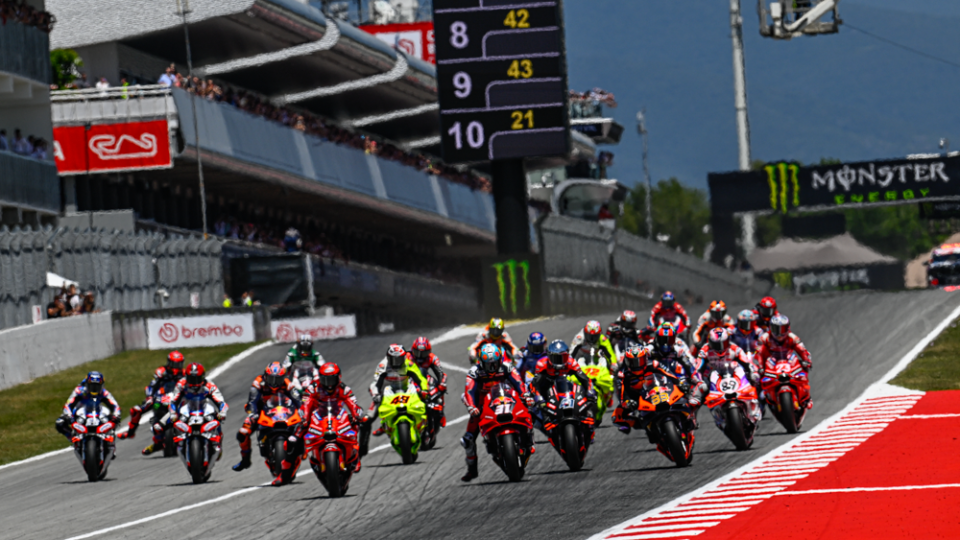
The dinner tables were set. The wine was poured. Liberty Media had flown in its most senior executives from the United States specifically to sit down with MotoGP’s manufacturers and build bridges at a lavish event in Jerez.
Nobody from Aprilia turned up. Nobody from KTM. Nobody from Yamaha.
The empty chairs said everything that months of careful diplomatic language had been trying to avoid saying out loud. More than half of MotoGP’s manufacturers decided to use the dinner to lob a grenade in Liberty’s direction. The sport that generates hundreds of millions of euros a year is in the middle of its most significant off-track battle in over a decade.
What Is Actually Being Fought Over
Every five years, MotoGP’s commercial owner sits down with manufacturers, teams and other stakeholders to agree the terms under which the championship operates. The current agreement expires at the end of 2026, and negotiations over the new deal covering 2027 to 2031 have been running for nearly a year.
This is MotoGP’s equivalent of Formula 1’s Concorde Agreement, the document that governs how money flows through the sport. And right now the two sides cannot agree on the most fundamental question of all: how should that money be split?
MotoGP generates somewhere between 460 and 480 million euros in annual revenue. Liberty’s current offer amounts to a set annual fee of around seven to eight million euros per factory team per season, a modest increase on existing payments. In return, Liberty wants manufacturers to take on greater responsibility for hospitality, marketing, social media and image promotion.
The manufacturers, grouped under the MSMA and led by president Massimo Rivola of Aprilia and Lin Jarvis as negotiating representative, want something completely different, a move away from fixed payments entirely, toward a percentage-based revenue share model like the one used in Formula 1.
The gap between those two positions is not a rounding error. It is a philosophical disagreement about what MotoGP is and who deserves to profit from it.
The Jerez Boycott: What Actually Happened
On the Friday evening before the 2026 Spanish Grand Prix, Liberty Media hosted its traditional casual dinner at the Bodegas Gonzalez Byass in Jerez. Liberty president Derek Chang attended alongside MotoGP CEO Carmelo Ezpeleta and his son Carlos. Christian Horner was there. So was Sean Bratches, one of Liberty’s most influential executives, who had flown in specifically to accelerate the negotiations.
What they got instead was a statement of intent. Ducati sent no senior executives only team manager Davide Tardozzi and a communications representative. Honda sent only Alberto Puig and two press officers. Aprilia, KTM and Yamaha sent nobody.
The empty tables in the centre of the dining hall were the manufacturers’ answer to Liberty’s latest counteroffer. In diplomatic terms, this was not a minor protest. This was a coordinated, deliberate act of collective defiance from the organisations that build and race the machines that make MotoGP worth watching.
Liberty’s Response: Divide and Conquer
Liberty did not react by softening its position. It responded by abandoning the collective negotiation entirely and switching to individual conversations with each manufacturer and team separately.
The logic is clear. The MSMA draws its power from unity. If Liberty can peel individual manufacturers away from the collective front, the remaining holdouts lose their leverage. And the tactic appears to be working. Honda and Ducati have reportedly moved closer to signing Liberty’s deal. Among the satellite teams, VR46, Gresini, LCR and Tech3 are all said to be open to the proposed terms.
Standing firm on the other side are Yamaha, Aprilia and KTM, three manufacturers with very different business situations but a shared conviction that Liberty’s fixed fee model undervalues their contribution to the sport.
The Numbers That Tell the Story
MotoGP currently makes around 210 million euros in annual profit. The manufacturers are targeting a deal that would give each team roughly 9.5 million euros per season under a 50 percent profit-share model. Liberty’s offer of eight million per factory team represents an increase of around one million on existing payments, a number the MSMA clearly considers an insult given the sport’s growth trajectory under Liberty’s ownership.
For context, Liberty itself is a corporation worth roughly ten times the market value of Ducati. It exists to make money for its executives and shareholders, not to keep paddock stakeholders comfortable. That commercial reality is precisely what makes this negotiation so difficult. Liberty wants MotoGP to grow the way F1 has grown under its ownership. The manufacturers agree that growth is desirable. They just want a guaranteed share of the proceeds.
The Rider Announcement Logjam
There is an unexpected casualty of this financial war that affects every fan following the 2027 rider market. Teams have been using 2027 rider announcements as leverage, withholding official confirmations as part of a coordinated MSMA strategy to maintain pressure on Liberty.
It is widely understood that most 2027 seats are already filled. Quartararo to Honda. Acosta to factory Ducati alongside Marquez. Alex Marquez to factory KTM. Bagnaia to Aprilia alongside Bezzecchi. None of it is official. Several announcements ready to be made have been put on hold pending progress in the talks.
The only confirmed piece of the 2027 grid is Marco Bezzecchi’s Aprilia renewal and that itself was a statement by the MSMA, confirming one deal to show they can play ball while withholding everything else as a pressure tactic.
What Happens if No Deal Is Reached
The MSMA holds significant power in this confrontation for one simple reason: without manufacturers, there is no racing. The last time MotoGP’s commercial owner fought a serious battle with manufacturers was over spec electronics software, when Honda threatened to withdraw. The owner’s answer was to threaten replacing prototype machinery with cheaper CRT bikes. That standoff ended in compromise. This one will too eventually.
Both sides are bound to reach an agreement because all stakeholders want a championship in 2027. The manufacturers have already committed millions of euros to developing 850cc prototypes. Liberty has committed billions to buying the sport. Neither side can afford to walk away.
After meetings at COTA and Jerez, Aprilia’s Massimo Rivola described talks as good and said both parties met with Derek Chang and were happy to move forward. That cautious optimism suggests the two sides are closer than the empty dinner chairs implied.
The Bigger Picture
What this fight is really about is the soul of MotoGP’s next chapter. Liberty transformed F1 from a niche technical series into a global entertainment product worth billions. It wants to do the same with MotoGP. The manufacturers understand that Liberty’s investment and reach could make MotoGP bigger than it has ever been.
They just want to be paid accordingly when it does.
Liberty is happy to play rough. After all, it exists to make money for its executives and shareholders, not to keep stakeholders happy. The manufacturers have decades of experience playing rough too. Somewhere between those two positions, a deal will get done.
The question is not whether MotoGP has a future after 2026. It does. The question is who controls that future, and how much of the money generated by the world’s greatest motorcycle racing championship ends up in the pockets of the people who actually build the bikes.
The empty tables at Jerez suggested the manufacturers know exactly what they are worth. Liberty’s response suggested it disagrees.
This one is going all the way to the wire.