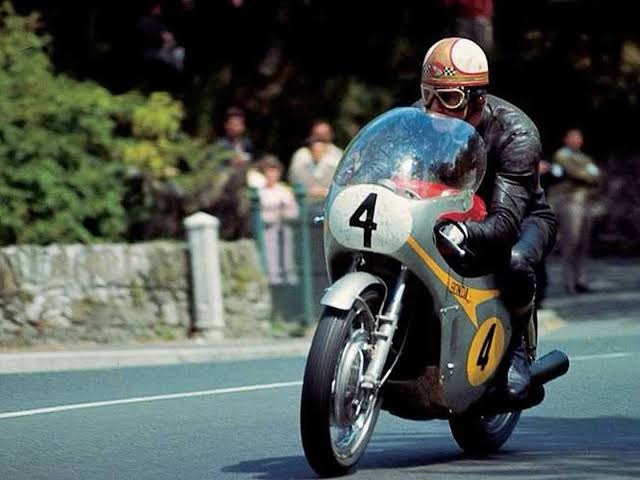
Stanley Michael Bailey Hailwood was born on 2 April 1940 in Great Milton, Oxfordshire. He died on 23 March 1981. He was 40 years old. In the years between those two dates, he became the most complete motorcycle racer the sport has ever produced, a Formula One driver with genuine ability, and a man whose greatest victory came not in his prime but after an 11 year absence from the sport he loved.
Nobody has ever done anything quite like it. Nobody ever will.
The Boy Who Was Born to Race
His father, Stanley William Bailey Hailwood, was a millionaire businessman and managing director of a car sales company, as well as a successful motorcycle dealer who had raced motorcycles in the pre-war era. Mike grew up with minibikes in fields near his home and watched his first race at the age of ten.
Most kids in that era came to racing through necessity, through borrowed machines and borrowed money. Mike had everything handed to him. His rivals resented it. His talent silenced them.
In 1957, Hailwood began his road racing career at 17, finishing 11th in his first race at Oulton Park, but was soon winning on a regular basis. He earned his international racing licence after only a few months of racing, something that took most riders several years to attain.
One year later, the sport stopped and stared. During the winter of 1957 to 1958, Hailwood went to South Africa to develop his skills further and returned home that spring as South Africa’s national champion. In his debut Grand Prix season of 1958, he won an incredible 74 races. The motorcycle press gave him a nickname that stuck for life. Mike the Bike.
The MV Agusta Years
By 1961, Hailwood was already a different class. In June 1961, he became the first man in the history of the Isle of Man TT to win three races in one week, taking victories in the 125cc, 250cc and 500cc categories. He missed a fourth only because his 350cc AJS broke while he was leading.
The Count of MV Agusta had seen enough. Count Domenico Agusta was very impressed and in 1961 he hired Hailwood to form a motorcycle and rider combination that in the following years proved unbeatable, winning four consecutive world titles from 1962 to 1965.
His reward across the full span of his career was nine motorcycling world titles. Four at 500cc, two at 350cc and three at 250cc. Over his 10-year Grand Prix career, Hailwood won 76 races, collected 112 podiums, and set 79 fastest laps from just 152 starts.
Those numbers are staggering. The ratio of wins to starts is still extraordinary by any era’s standards.
The Honda Challenge
In 1966 Hailwood made a move that defined his legacy as a racer. He left MV Agusta and signed for Honda. Honda had the most powerful engines at the time, but were known as difficult to ride because of their weak chassis. Hailwood’s great skill overcame the disadvantages, continuing to record world championships in 1966 and 1967.
The Honda years produced some of the most dramatic racing the sport has ever seen. The battles with Giacomo Agostini at MV Agusta were gladiatorial. In one legendary encounter, a loose throttle mechanism on the Honda threatened to end his race. In frustration, a mechanic tied a handkerchief tightly around the throttle in a last ditch effort to hold it in place. Hailwood valiantly fought the Honda in what appeared to be a hopeless effort to catch Agostini. Suddenly, on the last lap just a few miles from the finish, the chain on Agostini’s bike snapped. Hailwood sped past the freewheeling Italian and took the dramatic victory.
That story alone tells you everything about the man. He never let go.
Four Wheels
Honda pulled out of Grand Prix racing in 1968 but continued to pay Hailwood with the expectation of returning. Hailwood never returned to full-time motorcycle racing and instead elected to pursue a career in auto racing.
He was good on four wheels. Very good. But never transcendent in the way he had been on two. He participated in 50 Formula One Grands Prix, achieved two podium finishes, won the 1972 European Formula Two title, and earned a third place at the 1969 24 Hours of Le Mans.
In 1973 at Kyalami he did something that had nothing to do with racing and everything to do with character. Hailwood stopped his car on the circuit to pull Clay Regazzoni from his burning car after an accident, an act for which he was awarded the George Medal that year. Britain’s highest honour for civilian bravery. He wore it lightly, the way he wore everything.
His car racing career ended violently. He was challenging for fourth during the closing stages of the 1974 German Grand Prix when his car landed awkwardly at the Nürburgring and crashed head-on into the barriers. His right leg was broken in three places and that was the end of Hailwood’s motor racing career.
He retired to New Zealand. Most people assumed that was that.
The Greatest Comeback in Sport
Many consider Mike Hailwood’s TT comeback in 1978 as the greatest achievement by any rider in the entire history of motorcycle racing. It is difficult to argue otherwise.
The story began with a casual conversation. In the paddock, Hailwood was introduced to Steve Wynne, a Manchester based Ducati dealer. He saw the Ducati, swung his leg over it, and said “This is the kind of old fashioned bike I understand. Wouldn’t mind doing another TT on this!” Wynne said “Why don’t you?” And with just a few words and a handshake, the deal was done for a nominal rider’s fee of £1000.
The plan was almost comically modest. Hailwood still wasn’t sure how things would go and briefly considered racing under the assumed name of Edgar Jessop. He was 38 years old, his ankle reconstructed, his body carrying the damage of a lifetime at the absolute limit. The bookmakers were not interested in his chances.
In practice, Hailwood lit up the lap charts with a best lap of over 111mph, well above his own 1967 record of 107mph set on the Grand Prix Honda 500.
The paddock had its answer. The only question remaining was whether the bike would hold together.
His very first racing lap on the Ducati was his fastest ever lap of the TT course. He closed the gap on Phil Read on the factory Honda and fans around the course cheered wildly when they heard the announcement that Hailwood had passed Read on the road. Read’s Honda broke down on the fifth lap. Hailwood won. Grown men, including Mike himself, wept as he crossed the finish line on Glencrutchery Road.
The engine on the Ducati had also blown up internally as Mike crossed the finish line. It had given everything it had, and so had he.
One Final Year
Hailwood returned to the TT in 1979. He rode a two-stroke Suzuki RG500 to victory in the Senior TT and then used that same 500cc bike in the Unlimited Classic, dicing for the lead with Alex George on a 1100cc Honda for all six laps, losing by two seconds.
He retired for good at 39. Opened a Honda dealership in Birmingham with former racer Rodney Gould. Tried to build a normal life.
On Saturday 21 March 1981, Hailwood set off in his Rover SD1 with his children Michelle and David to collect some fish and chips. As they returned along the A435, a lorry made an illegal turn through the barriers onto the central reservation and their car collided with it. Michelle, aged nine, was killed instantly. Mike died two days later from severe internal injuries. He was 40 years old.
What He Left Behind
The FIM named Hailwood a Grand Prix Legend in 2000. He was inducted into the AMA Motorcycle Hall of Fame that same year and the International Motorsports Hall of Fame in 2001. A section of the Snaefell Mountain Course was named Hailwood’s Rise, leading to the highest point at Hailwood’s Height, in his honour.
After his 1978 TT victory, Ducati offered a 900SS based Mike Hailwood Replica for sale. Approximately 7,000 were sold. His win quite possibly saved Ducati as a motorcycle manufacturer. The brand took that one race result and turned it into a commercial lifeline.
The argument over who was the greatest motorcycle racer of all time runs through every generation of the sport. Agostini has 15 world titles. Rossi has a career spanning 25 years. Marquez rewrote the MotoGP record books.
But none of them came back after 11 years, with a reconstructed ankle, on an unfancied Italian V-twin, and beat the factory opposition around the most dangerous racetrack on earth.
Only one man did that.
Mike the Bike.