The on track action at COTA was gripping. But the most important meeting of the MotoGP weekend did not happen on the Circuit of The Americas. It happened in a hospitality suite, over a table, between the men who actually run this sport.
MotoGP manufacturers left Austin feeling “happy” after a crunch meeting with Liberty Media during the US Grand Prix weekend. With eight months to go until the end of the current 1000cc era, manufacturers are yet to sign a new agreement to compete in MotoGP from 2027 onwards. That unsigned contract is the reason why the 2027 rider market, one of the most seismic in MotoGP history, has been in public limbo for months.
The stakes are enormous. The moves are essentially done. The announcements are not.
What the Texas Meeting Actually Was
The ongoing discussions between MotoGP Sports Entertainment Group and the MSMA have been running for nearly a year. At stake is a new agreement covering the 2027 to 2031 period, outlining rights and obligations on both sides, as well as the distribution of revenues generated from the championship’s commercial rights, primarily television.
Think of it as MotoGP’s version of Formula 1’s Concorde Agreement. And like the original Concorde negotiations in F1, it has been neither quick nor straightforward.
KTM motorsport director Pit Beirer posted a social media picture from Austin alongside Liberty CEO Derek Chang, Liberty board member Robert R. Bennett, MotoGP CEO Carmelo Ezpeleta and KTM CEO Gottfried Neumeister. Ducati CEO Claudio Domenicali was also present. So was Piaggio Group CEO Michele Colaninno, who accepted the Americas GP winner’s trophy on behalf of Aprilia. The CEOs of five manufacturers were in the same room with the most powerful people at Liberty Media. That does not happen by accident.
Unlike previous years, the five manufacturers have been negotiating as one with commercial rights holder MotoGP Sports Entertainment Group. That united front has been a deliberate strategy, giving the manufacturers collective leverage they have never previously deployed in these negotiations.
What They Are Actually Fighting Over
The core dispute is money. Specifically, how it gets shared.
The manufacturers are pushing for a percentage based model tied to overall revenue. That is the system used in Formula 1, which, like MotoGP, is owned by Liberty Media. The argument from the manufacturers is logical: Liberty’s involvement will grow the sport, revenues will rise, and the factories want a direct cut of that growth rather than a fixed payment that stays flat regardless of how big the pie gets.
MotoGP Sports Entertainment, by contrast, wants to maintain the existing structure with improved financial terms. They want the revenue upside for themselves. They want commitments from manufacturers on promotional activity in return. Neither side is being unreasonable. Both sides want MotoGP to exist in 2027. The argument is purely about who profits most from its success.
Another key issue concerns the ownership of grid slots. Under the current agreement, those entries are controlled by MotoGP Sports Entertainment. Teams are pushing to change that, arguing that holding the rights themselves would significantly increase their value when negotiating with sponsors and potential investors.
This is the Formula 1 model again. In F1, teams own their entries. It is a significant commercial and structural shift, and MotoGP Sports Entertainment has no obvious incentive to give that power away.
Why the Rider Market Is Frozen
Every major 2027 rider deal is done in principle. None of them are announced. That is not a coincidence.
The manufacturers have withheld official confirmation of their 2027 rider lineups as a form of leverage. It is a calculated pressure strategy. No signed commercial agreement means no security over grid slots for 2027. No security over grid slots means manufacturers have a reasonable argument that they cannot formally commit budget to rider contracts. The whole market hangs in a carefully constructed chain of deliberate delay.
Deals widely reported but yet to be announced include Pedro Acosta to Ducati, Francesco Bagnaia to Aprilia, Fabio Quartararo to Honda and Alex Marquez to KTM, plus a contract extension for reigning champion Marc Marquez at Ducati.
That is five of the most significant riders in the sport, all in limbo on paper.
Bagnaia held talks with Yamaha. The all round struggles of the Japanese manufacturer, combined with what he considered an insufficient offer, prompted him to change direction and commit to Aprilia, where he will team up with Bezzecchi. In response, Yamaha secured Jorge Martin, while discussions continue over who will partner the 2024 world champion.
The dominoes are lined up. Someone just needs to push the first one.
The Emerging Picture for 2027
Beyond the headline factory moves, the junior ranks are feeding directly into the premier class reshuffle. According to reports from Spanish sports newspaper AS and journalist Mela Chercoles, Moto2 stars David Alonso and Dani Holgado are set to make the leap to the premier class in 2027. Alonso is heading to Honda, while Holgado is set to join Gresini Ducati.
Alonso is no ordinary rookie prospect. The Colombian, born in Spain, delivered a historic Moto3 title winning campaign in 2024, winning 14 races before stepping to Moto2. Honda pairing him with Quartararo would give them one of the most exciting lineups they have fielded in years.
KTM Motorsport Director Pit Beirer confirmed at COTA that they were in talks with both Alonso and Holgado about 2027 MotoGP moves. Both riders currently race in Moto2 under the KTM umbrella at CFMoto Aspar. Losing them to rivals would represent a painful talent drain at a moment when KTM needs good news.
KTM’s position heading into 2027 is genuinely complicated. Acosta is expected to leave for Ducati, and Binder, Bastianini and Vinales have all struggled badly in 2026. The Austrian manufacturer is potentially facing a 2027 grid reset with none of their current headline acts and reduced competitive relevance at the exact moment the sport resets under new technical regulations.
The 850cc Revolution Nobody Has Formally Signed Up For
Here is the remarkable fact sitting underneath all of this: no manufacturer has formally signed a contract to participate in MotoGP from 2027 onwards. All five factories are building 850cc bikes. KTM and Honda have prototype versions already on track. Ducati, Aprilia and Yamaha confirm in factory development. Billions of euros in combined engineering investment are committed to a championship that technically has no signed competitors yet.
Everyone knows they are all staying. The negotiations are about the terms, not the presence. But the optics of an unsigned agreement, eight months before the most significant rule change in two decades, creates a genuine cloud over a sport that should be celebrating its strongest commercial moment in years.
One of the knock on effects expected from a signed deal is a wave of announcements concerning the 2027 rider market and team manufacturer partnerships. Only Marco Bezzecchi’s renewal with Aprilia has been officially confirmed so far, and that is far from coincidental.
If the Austin meeting produced genuine positive momentum, the extended break before Jerez could finally unlock that wave. The Qatar postponement gives the paddock a rare window of calm between races. A smart negotiator would use it.
What Comes Next
Liberty Media’s track record with Formula 1 is the reason manufacturers want a percentage of revenue. They watched Liberty turn F1 from a niche European motorsport into a global entertainment property, triple the broadcast deals and launch one of the most successful sports documentaries in streaming history. They want the same energy applied to MotoGP, and they want a share of the proceeds when it arrives.
The manufacturers are not wrong to want it. Liberty is not wrong to protect its commercial upside. The gap between those positions has closed considerably in recent weeks according to Motorsport.com sources. A breakthrough before Jerez is possible. It may already be done.
When the agreement lands, the 2027 rider market will detonate. Every deal that has been sitting in a drawer for months will go public inside a week. The biggest grid reshuffle in modern MotoGP history will officially begin.
The sport is ready. The riders are ready. The manufacturers are building the bikes.
Now someone just needs to sign the paper.
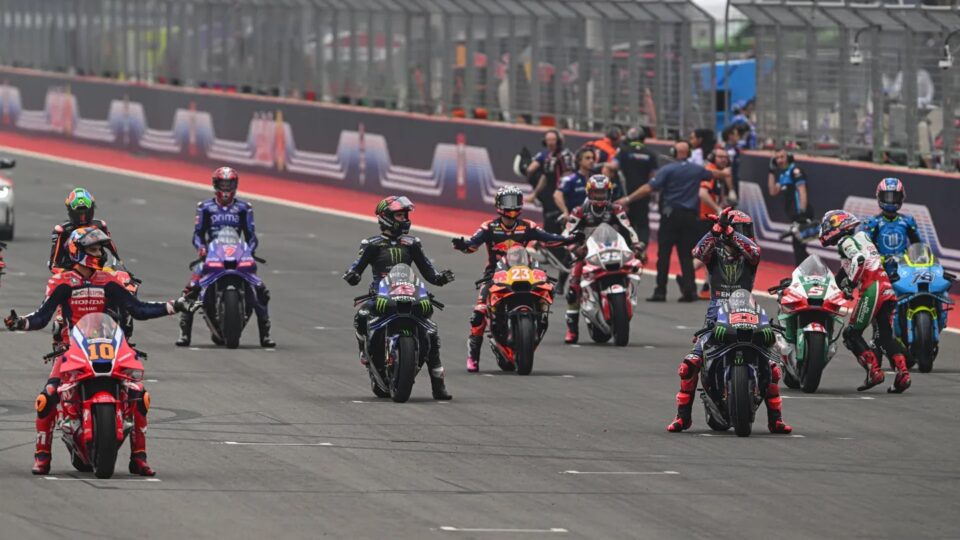
Deep Dive · 7 min read
Deep Dive
MotoGP’s Biggest Backstage Drama: The Deal That Is Holding Up the Entire 2027 Rider Market
Advertisement
Advertisement
Advertisement
More Stories