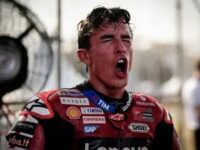
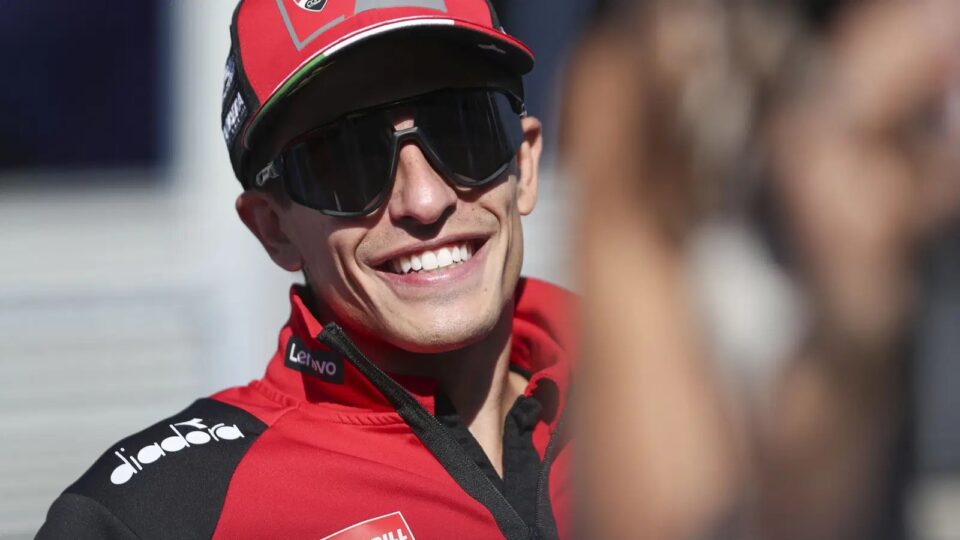
Marc Marquez fractured the fifth metatarsal in his right foot and will miss at least the French Grand Prix and the Catalan Grand Prix while he undergoes surgery in Madrid.
What nobody outside the Ducati garage knew was that surgery had already been planned. Marquez was already booked in for a shoulder operation after Barcelona, a loose screw from his 2025 Indonesian Grand Prix injury had been pressing on his radial nerve all season, causing the arm to disconnect from what his brain was telling it to do.
In Marquez’s own words: “I had a very strange feeling, because at home I was fine. I’d come here to MotoGP races and it would be bad. So I thought I was mentally blocked. But they saw that in the MotoGP position, that screw was touching my radial nerve and that’s what makes me fail. It makes me inconsistent. It makes me have unexpected crashes.”
So the highside at Le Mans was not simply a mistake. It was the consequence of a rider who had been fighting a nerve problem all season without fully understanding why his body kept betraying him at the worst possible moments.
That context makes everything that follows more important. Not just the injury. The bigger question it forces us to ask.
The Uncomfortable Question
What does MotoGP look like without Marc Marquez?
MotoGP fans are already urging Marquez to sit out potentially the rest of 2026 and fully recover before returning. One sentiment echoing loudest across social media is the comparison to his nightmare years at Honda after the 2020 Spanish Grand Prix surgery, multiple operations, compromised performances, a rider trying to race through pain that was actively working against him.
The worry is that history repeats itself. That Marquez returns too soon, crashes again, and the cycle of surgery and comeback continues until the point where the body simply stops cooperating.
Marquez himself acknowledged the timing, saying this injury arrives at the correct time because surgery was already planned. He called it not a very big injury in the circumstances. That is the mind of a competitor talking reframing a serious injury as an acceptable obstacle rather than a reason to stop. It is admirable. It is also the same thinking that prolonged his Honda misery for four years.
The Dependency Problem
The person who submitted this question to Racing60 put it better than most analysts have managed: MotoGP has become reliant on Marquez in the same way it was once reliant on Valentino Rossi.
That dependency is not coincidental. It is the product of deliberate broadcast and promotional strategy. After the Bezzecchi collision in Mandalika last year, a significant portion of the following week’s coverage revolved around Marquez. His injury. His future. His reaction. His recovery. His return timeline.
The sport has form here. Given the years of misery Marquez went through at Honda after requiring multiple surgeries following his 2020 highside, the idea that his season should not continue until he is fully fit has resonated strongly with fans. The difference this time is that those fans are not just hoping he recovers. They are asking whether MotoGP can afford to tell its story without him at the centre of it.
The honest answer is that Dorna and Liberty Media have not yet proven they can.
What Liberty Needs to Do
Formula 1 offers the clearest template for what MotoGP needs to build. Until 2017, F1 highlights were almost impossible to find legally on social media. Bernie Ecclestone viewed YouTube as a threat rather than a marketing tool. The championship had stars Hamilton, Vettel, Alonso but those stars existed in a closed ecosystem that casual fans could not easily access.
Drive to Survive changed everything. Not because it was accurate plenty of F1 insiders will tell you it was not, but because it made personalities out of engineers, team principals and mid-grid drivers that nobody outside the paddock had ever heard of. It created investment in the sport before a single lap had been watched.
MotoGP’s social media presence is improving but remains structurally weak in comparison. The highlights problem is real. The famous Top 3 Moments format helps dedicated fans but does nothing for casual discovery. A first-time viewer in Australia or the United States who wants to understand what makes Pedro Acosta extraordinary or why the Martin versus Bezzecchi title fight matters cannot find a compelling three-minute entry point that delivers it.
Liberty Media has shown it understands this. The infrastructure it built around F1, the Netflix deal, the social media strategy, the celebrity partnerships took years to deliver results. MotoGP is at the beginning of that same process.
Who Can Actually Fill The Void
The good news and this is genuinely good news is that the 2026 MotoGP grid is richer in personality and talent than at any point in the post-Rossi era.
Marco Bezzecchi leads the championship by 51 points following Marquez’s Le Mans Sprint crash, with Jorge Martin six points behind him after his dominant Sprint victory. Two compelling, contrasting personalities already deep in a title fight that has produced extraordinary racing. Bezzecchi the instinctive, emotional Italian. Martin the calculating, relentless Spaniard.
Pedro Acosta is 21 years old and already fourth in the championship. His MotoGP debut last year was the most breathtaking arrival of a new talent since Marquez himself in 2013. When Acosta is on it truly on it, he does things that make experienced observers reach for historical comparisons. That kind of generational talent does not need Marquez’s absence to become relevant. It needs Liberty’s broadcast machine to tell the story properly.
Alex Marquez is quietly becoming one of the most complete riders in the championship. He won back to back Spanish Grands Prix. He is faster on Sunday than almost anyone in the field. His relationship with his brother complex, loving, competitive is one of the most compelling human stories MotoGP has ever had access to and barely knows what to do with.
Fabio Quartararo is fighting the Yamaha V4 with the kind of raw determination that turned him into a world champion in 2021. His war with a machine that refuses to cooperate is a story in itself. His chemistry with the Le Mans crowd represents exactly the kind of local, passionate, culturally specific connection that Liberty needs to replicate in every market.
The Retirement Question
Could Marquez retire? The question feels premature. He is 33 years old. He remains, when healthy, the most dangerous qualifier and one-lap performer on the grid. He has said the shoulder recovery should be relatively uncomplicated and the foot fracture was not considered a major injury by his own assessment.
But the accumulation is real. The 2011 crash. The 2020 highside. The 2021 operations. The years of Honda misery. The Indonesian collision in 2025. Now a loose screw pressing on his radial nerve all season and a broken metatarsal from a highside that his own body arguably caused.
Every comeback has produced the same pattern: extraordinary performances mixed with sudden, unexplained crashes that made no sense given his experience level. We now know why. The nerve issue explains it. The question is whether surgery fixes it completely, or whether the next problem in the next crash starts another cycle.
If Marquez does retire, whether at the end of 2026 or after a successful comeback and title in 2027 or 2028 MotoGP will not fold. The racing will still be spectacular. The storylines will still be compelling. Bezzecchi and Martin and Acosta and Alex Marquez will still be extraordinary to watch.
But the sport will face the same challenge it faced when Rossi finally left. The machine needs a new face to sell to the world. Liberty has the tools Dorna never had. The social reach, the broadcast infrastructure, the Netflix deal potential, the commercial muscle to make stars out of riders that half the world does not yet know exist.
The Marquez era will end eventually. Every era does. What happens next depends entirely on whether Liberty Media learned the right lessons from watching Formula 1 rebuild its global fanbase one highlighted moment at a time.
The grid is full of future stars. Someone just needs to tell their stories properly.